
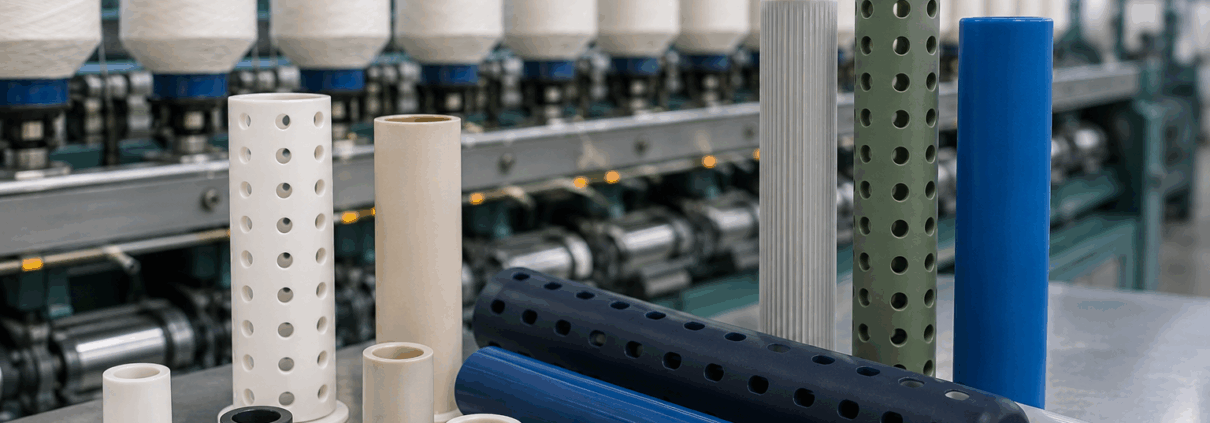
The role of components in keeping textile production running

In the textile sector, the quality of the finished product does not depend on yarns and machinery alone, but also on a category of elements that is often underestimated: textile machinery accessories. Cones, tubes and supports follow the yarn through every stage of processing and, for this very reason, their reliability has a direct impact on production continuity and on the quality of the result.

An imprecise or fragile component can lead to machine downtime, waste and irregularities that affect the entire line. In this article we will look at why the quality of textile accessories truly makes the difference, with particular focus on plastic tubes for yarn and on the technical criteria to evaluate, such as diameter, length and constructional features, in order to choose the most suitable component for each production process.

Why accessory quality affects the entire process

The quality of textile accessories is measured across three closely connected levels. The first is operational continuity: reliable components reduce machine downtime and unplanned interruptions. The second is processing quality: a stable, precise support ensures the yarn unwinds evenly, limiting abnormal tension and defects on the finished product. The third is durability over time, because a robust accessory withstands repeated cycles and contact with water, heat and the chemical agents typical of operations such as dyeing.

The three levels that define quality

The quality of textile accessories is measured across three closely connected levels. The first is operational continuity: reliable components reduce machine downtime and unplanned interruptions. The second is processing quality: a stable, precise support ensures the yarn unwinds evenly, limiting abnormal tension and defects on the finished product. The third is durability over time, because a robust accessory withstands repeated cycles and contact with water, heat and the chemical agents typical of operations such as dyeing.

Technical components, not more consumables

Seen in this light, accessories for the textile industry should be considered not as simple consumables but as technical components capable of directly influencing production efficiency and costs. Compatibility with the yarn accessories and machine parts already in use also becomes a decisive factor in ensuring smooth integration along the entire line.

Among the most widely used accessories in yarn processing, plastic tubes for yarn deserve particular attention, because their selection directly influences winding performance and compatibility with the machinery. Let’s look at the technical parameters to evaluate.

Diameter

Diameter is the first figure to check, as it determines how the tube couples with spindles and mandrels. A value that does not match the machine standard undermines stability during rotation.

Inner and outer diameter

In practice it is important to distinguish between the inner diameter, which governs the fit onto the machine support, and the outer diameter, which affects winding capacity and how the yarn behaves in the following stages. A correct balance between the two values avoids excessive play and ensures smooth rotation.

Length

The length of the tube should be chosen according to the useful travel of the machine and the amount of yarn to be wound. An unsuitable size either reduces the capacity of the support or leaves unused portions, with a direct impact on cycle efficiency.

Constructional features and material

Beyond dimensions, the geometry and material of the component also matter.

Precision and dimensional tolerances

Consistency of measurements throughout the entire production run is essential: small variations generate irregularities that are difficult to control. This is precisely why dimensional tolerances in textile cones and tubes are a factor where precision genuinely makes the difference.

Material and resistance

Tubes made of plastic through injection moulding offer lightness, dimensional stability and good resistance to moisture and stress, features that make them suitable even for the most intensive cycles. The range of cylindrical tubes meets these needs with solutions designed for different operations.

How component choice affects costs and efficiency

Carefully evaluating tubes and, more broadly, textile machinery accessories is not a purely technical exercise: it is a decision that produces measurable effects on the economic and organisational side. Components chosen with the right criteria influence several fronts that, over time, make the difference to margins.

Reducing waste and machine downtime

A precise, compatible accessory keeps the process stable, limiting processing waste and interruptions. Every unplanned stoppage carries a cost that goes beyond the single component, because it involves machine time, labour and the restarting of production.

The hidden cost of non-conformities

A support that is out of tolerance can go unnoticed until far downstream, when the defect emerges on the yarn or on the finished product. Catching quality upstream, at the level of the yarn carrier and the other supports, means avoiding costs that would otherwise multiply along the line.

Efficiency and durability over time

Robust components withstand repeated cycles and retain their characteristics even in the presence of water, heat and chemical agents. This longevity reduces the frequency of replacements and ensures consistent output, contributing to a better ratio between initial investment and performance achieved.

From the component to an informed choice

The quality of a tube or a cone reveals itself in everyday use: in how evenly the yarn unwinds, in how well the measurements hold after many cycles, in the ability to maintain the same performance even after passing through dyeing. These are details that are rarely noticed when everything runs smoothly, and that become obvious only when something goes wrong.

This is why the selection of textile machinery accessories is best approached by starting from the actual operation: the type of yarn, the machine the component will be mounted on, the conditions it will be exposed to. Comparing these parameters with the technical characteristics of the product is the most direct way to identify the right solution and avoid choices that need to be reconsidered later. The section dedicated to accessories for the textile industry brings together the different types available, useful as a reference for comparing formats, sizes and fields of application.


Textile industry 4.0: how technology can help companies’ competitiveness

Industry 4.0 is a revolution that is changing the way textile companies design, develop and produce their products and interface with customers. Industry 4.0 relies on the use of digital technology to increase productivity and product quality and reduce costs. Textile companies are investing in advanced technologies, such as iot, artificial intelligence and robotics, to improve their competitiveness, flexibility and efficiency. Thanks to the new technologies it is possible to guarantee an optimal management of the raw materials and of every phase of the production process, from the realization up to the delivery of the finished product. Industry 4.0 in textiles also allows monitoring of production processes and providing customers with real-time information on the status of their orders.

But what is meant, specifically, by industry 4.0 in textiles? And what can be the advantages for a company? Let’s find out together!

What is Industry 4.0?

Industry 4.0, also known as the Fourth Industrial Revolution, is a term that describes the ongoing transformation of manufacturing, based on the use of advanced technologies such as artificial intelligence and robotics, and the collection and analysis of information through Learning Machine processes to improve the management of the production cycle. Industry 4.0 represents a new era in production, in which machines are able to communicate with each other and to interface with humans in an increasingly fluid way. This change is transforming the way companies produce and distribute their products, offering new opportunities to increase efficiency and flexibility. The technologies that are driving Industry 4.0 are constantly evolving, and their impacts on the industry are still largely unknown. However, it is clear that this new era of production will bring profound changes in business models and industrial processes, offering new challenges and opportunities for companies around the world.

How does Industry 4.0 work?

Adopting new technologies 4.0 means working by digitizing processes and then rethinking your business model. Digital transformation is not only about buying new machinery or reviewing processes, but also about profound change and improvement of all business processes. Technological innovation is also necessary to meet the growing demands in terms of respect for the environment and greater attention to the environmental sustainability of production processes. Key technologies used in Industry 4.0 include:

  • artificial intelligence, that is the application of algorithms of machine learning in the business processes, both regarding the production and the management and maintenance of the machinery;
  • data analysis, to meet the real needs of the market, defined on the basis of a careful scientific analysis;
  • digital printing technologies to make production processes more efficient and reduce resource consumption;
  • Internet of Things (IoT) to connect all parts of a company through the network and make the supply chain more sustainable, but also to control and manage production, the warehouse and the fleet;
  • Cloud to allow an integrated management of the various departments and streamline information flows by improving and making more secure the sharing of information within the company;
  • Digital Finance to facilitate and make the integrated administrative management faster and more immediate. A digital management of corporate finance is also useful for accurately and efficiently controlling revenue and expenditure, thus improving work processes.

Beschi and Industry 4.0: digital innovation to improve production efficiency

Beschi constantly invests in digital innovation to offer customers an increasingly efficient, modern and up-to-date service. For this reason, the company focuses on Industry 4.0, that is, an increasingly connected, automated and optimized vision of the company in terms of management, which is able to combine the Italian artisan tradition with the most advanced technologies, also with a view to improving the environmental sustainability of the textile industry. As of 2017, Beschi has invested in the renewal of the machinery fleet and to date 70% of the presses are equipped with the latest generation of equipment, with a consequent improvement in production efficiency.

The company has also invested in internal digitalization, to computerize and interconnect all business processes: from the insertion of customer and supplier orders to the scheduling of the work plan, from the loading to the destination with delivery date of the products, until the sale to the customer. This has allowed us to offer customers more flexible, faster, punctual and higher quality services, with a significant optimization of costs and improvement of production.

a:7:{s:8:”location”;a:24:{i:0;a:1:{i:0;a:3:{s:5:”param”;s:13:”post_taxonomy”;s:8:”operator”;s:2:”==”;s:5:”value”;s:19:”product_cat:buttons”;}}i:1;a:1:{i:0;a:3:{s:5:”param”;s:13:”post_taxonomy”;s:8:”operator”;s:2:”==”;s:5:”value”;s:19:”product_cat:inserts”;}}i:2;a:1:{i:0;a:3:{s:5:”param”;s:13:”post_taxonomy”;s:8:”operator”;s:2:”==”;s:5:”value”;s:16:”product_cat:pins”;}}i:3;a:1:{i:0;a:3:{s:5:”param”;s:13:”post_taxonomy”;s:8:”operator”;s:2:”==”;s:5:”value”;s:21:”product_cat:biconical”;}}i:4;a:1:{i:0;a:3:{s:5:”param”;s:13:”post_taxonomy”;s:8:”operator”;s:2:”==”;s:5:”value”;s:23:”product_cat:cylindrical”;}}i:5;a:1:{i:0;a:3:{s:5:”param”;s:13:”post_taxonomy”;s:8:”operator”;s:2:”==”;s:5:”value”;s:18:”product_cat:pulley”;}}i:6;a:1:{i:0;a:3:{s:5:”param”;s:13:”post_taxonomy”;s:8:”operator”;s:2:”==”;s:5:”value”;s:21:”product_cat:spacers-b”;}}i:7;a:1:{i:0;a:3:{s:5:”param”;s:13:”post_taxonomy”;s:8:”operator”;s:2:”==”;s:5:”value”;s:30:”product_cat:hooks-for-curtains”;}}i:8;a:1:{i:0;a:3:{s:5:”param”;s:13:”post_taxonomy”;s:8:”operator”;s:2:”==”;s:5:”value”;s:19:”product_cat:bumpers”;}}i:9;a:1:{i:0;a:3:{s:5:”param”;s:13:”post_taxonomy”;s:8:”operator”;s:2:”==”;s:5:”value”;s:34:”product_cat:number-cover-for-bingo”;}}i:10;a:1:{i:0;a:3:{s:5:”param”;s:13:”post_taxonomy”;s:8:”operator”;s:2:”==”;s:5:”value”;s:30:”product_cat:antiupsetting-feet”;}}i:11;a:1:{i:0;a:3:{s:5:”param”;s:13:”post_taxonomy”;s:8:”operator”;s:2:”==”;s:5:”value”;s:30:”product_cat:for-octagonal-tube”;}}i:12;a:1:{i:0;a:3:{s:5:”param”;s:13:”post_taxonomy”;s:8:”operator”;s:2:”==”;s:5:”value”;s:25:”product_cat:for-oval-tube”;}}i:13;a:1:{i:0;a:3:{s:5:”param”;s:13:”post_taxonomy”;s:8:”operator”;s:2:”==”;s:5:”value”;s:32:”product_cat:for-rectangular-tube”;}}i:14;a:1:{i:0;a:3:{s:5:”param”;s:13:”post_taxonomy”;s:8:”operator”;s:2:”==”;s:5:”value”;s:26:”product_cat:for-round-tube”;}}i:15;a:1:{i:0;a:3:{s:5:”param”;s:13:”post_taxonomy”;s:8:”operator”;s:2:”==”;s:5:”value”;s:27:”product_cat:for-square-tube”;}}i:16;a:1:{i:0;a:3:{s:5:”param”;s:13:”post_taxonomy”;s:8:”operator”;s:2:”==”;s:5:”value”;s:36:”product_cat:holder-for-car-documents”;}}i:17;a:1:{i:0;a:3:{s:5:”param”;s:13:”post_taxonomy”;s:8:”operator”;s:2:”==”;s:5:”value”;s:35:”product_cat:angle-bases-for-shelves”;}}i:18;a:1:{i:0;a:3:{s:5:”param”;s:13:”post_taxonomy”;s:8:”operator”;s:2:”==”;s:5:”value”;s:27:”product_cat:for-oval-tube-b”;}}i:19;a:1:{i:0;a:3:{s:5:”param”;s:13:”post_taxonomy”;s:8:”operator”;s:2:”==”;s:5:”value”;s:34:”product_cat:for-rectangular-tube-b”;}}i:20;a:1:{i:0;a:3:{s:5:”param”;s:13:”post_taxonomy”;s:8:”operator”;s:2:”==”;s:5:”value”;s:28:”product_cat:for-round-tube-b”;}}i:21;a:1:{i:0;a:3:{s:5:”param”;s:13:”post_taxonomy”;s:8:”operator”;s:2:”==”;s:5:”value”;s:29:”product_cat:for-square-tube-b”;}}i:22;a:1:{i:0;a:3:{s:5:”param”;s:13:”post_taxonomy”;s:8:”operator”;s:2:”==”;s:5:”value”;s:28:”product_cat:for-round-tube-c”;}}i:23;a:1:{i:0;a:3:{s:5:”param”;s:13:”post_taxonomy”;s:8:”operator”;s:2:”==”;s:5:”value”;s:29:”product_cat:for-square-tube-c”;}}}s:8:”position”;s:15:”acf_after_title”;s:5:”style”;s:7:”default”;s:15:”label_placement”;s:3:”top”;s:21:”instruction_placement”;s:5:”label”;s:14:”hide_on_screen”;a:3:{i:0;s:10:”discussion”;i:1;s:8:”comments”;i:2;s:15:”send-trackbacks”;}s:11:”description”;s:9:”minuteria”;}

a:7:{s:8:”location”;a:18:{i:0;a:1:{i:0;a:3:{s:5:”param”;s:13:”post_category”;s:8:”operator”;s:2:”==”;s:5:”value”;s:14:”category:cones”;}}i:1;a:1:{i:0;a:3:{s:5:”param”;s:13:”post_category”;s:8:”operator”;s:2:”==”;s:5:”value”;s:44:”category:for-covering-air-intermingled-yarns”;}}i:2;a:1:{i:0;a:3:{s:5:”param”;s:13:”post_category”;s:8:”operator”;s:2:”==”;s:5:”value”;s:32:”category:for-dyeing-and-steaming”;}}i:3;a:1:{i:0;a:3:{s:5:”param”;s:13:”post_category”;s:8:”operator”;s:2:”==”;s:5:”value”;s:40:”category:for-elastomer-and-elastic-yarns”;}}i:4;a:1:{i:0;a:3:{s:5:”param”;s:13:”post_category”;s:8:”operator”;s:2:”==”;s:5:”value”;s:39:”category:for-texturing-twisting-winding”;}}i:5;a:1:{i:0;a:3:{s:5:”param”;s:13:”post_category”;s:8:”operator”;s:2:”==”;s:5:”value”;s:23:”category:bearing-covers”;}}i:6;a:1:{i:0;a:3:{s:5:”param”;s:13:”post_category”;s:8:”operator”;s:2:”==”;s:5:”value”;s:13:”category:caps”;}}i:7;a:1:{i:0;a:3:{s:5:”param”;s:13:”post_category”;s:8:”operator”;s:2:”==”;s:5:”value”;s:27:”category:caps-for-unwinding”;}}i:8;a:1:{i:0;a:3:{s:5:”param”;s:13:”post_category”;s:8:”operator”;s:2:”==”;s:5:”value”;s:33:”category:cover-edge-for-unwinding”;}}i:9;a:1:{i:0;a:3:{s:5:”param”;s:13:”post_category”;s:8:”operator”;s:2:”==”;s:5:”value”;s:14:”category:disks”;}}i:10;a:1:{i:0;a:3:{s:5:”param”;s:13:”post_category”;s:8:”operator”;s:2:”==”;s:5:”value”;s:36:”category:flange-for-weaving-machines”;}}i:11;a:1:{i:0;a:3:{s:5:”param”;s:13:”post_category”;s:8:”operator”;s:2:”==”;s:5:”value”;s:14:”category:rings”;}}i:12;a:1:{i:0;a:3:{s:5:”param”;s:13:”post_category”;s:8:”operator”;s:2:”==”;s:5:”value”;s:28:”category:rings-for-unwinding”;}}i:13;a:1:{i:0;a:3:{s:5:”param”;s:13:”post_category”;s:8:”operator”;s:2:”==”;s:5:”value”;s:30:”category:separators-per-dyeing”;}}i:14;a:1:{i:0;a:3:{s:5:”param”;s:13:”post_category”;s:8:”operator”;s:2:”==”;s:5:”value”;s:25:”category:spacers-for-tube”;}}i:15;a:1:{i:0;a:3:{s:5:”param”;s:13:”post_category”;s:8:”operator”;s:2:”==”;s:5:”value”;s:16:”category:springs”;}}i:16;a:1:{i:0;a:3:{s:5:”param”;s:13:”post_category”;s:8:”operator”;s:2:”==”;s:5:”value”;s:23:”category:strible-holder”;}}i:17;a:1:{i:0;a:3:{s:5:”param”;s:13:”post_category”;s:8:”operator”;s:2:”==”;s:5:”value”;s:17:”category:trackers”;}}}s:8:”position”;s:15:”acf_after_title”;s:5:”style”;s:7:”default”;s:15:”label_placement”;s:3:”top”;s:21:”instruction_placement”;s:5:”label”;s:14:”hide_on_screen”;a:3:{i:0;s:10:”discussion”;i:1;s:8:”comments”;i:2;s:15:”send-trackbacks”;}s:11:”description”;s:7:”tessile”;}