
What is yarn twisting?
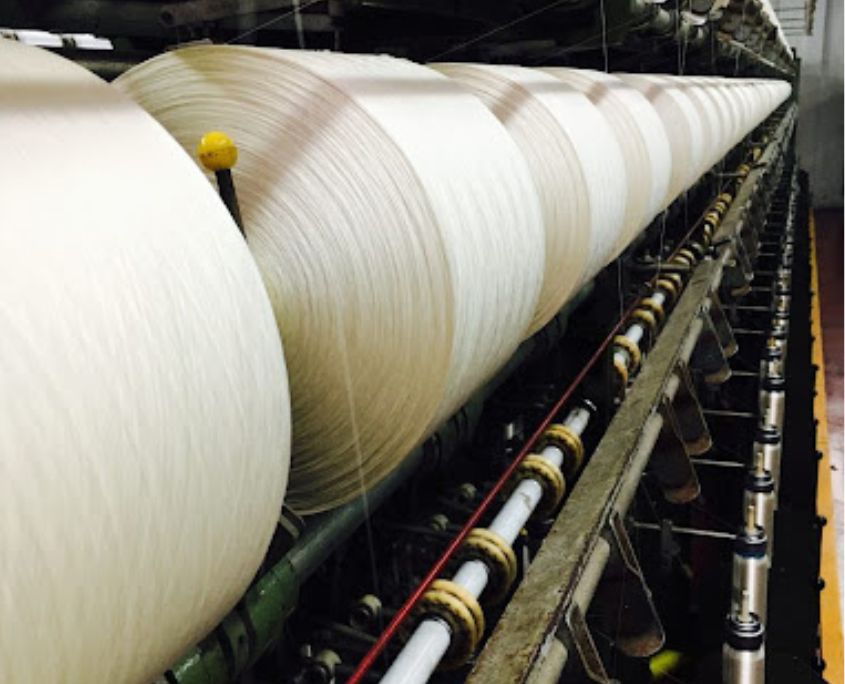
The process that gives yarns strength. compactness and elasticity in textile production
Yarn twisting is one of the most important and fascinating processes in the textile industry. It is the process through which a set of fibers is wound upon itself, giving the yarn greater cohesion, strength and stability.
This seemingly simple step defines many of the final properties of the yarn such as elasticity, hand and luster and directly affects the appearance and quality of the finished fabric. Without proper yarn twisting, it would not be possible to obtain resistant, uniform products suitable for subsequent processes such as weaving or knitting.
Let’s take a closer look at what it consists of.
What is twisting and why is it essential
Twisting consists of rotating a bundle of fibers upon itself, creating a helical movement that compacts and binds them. This operation, also called “torsion”, can be carried out in Z-direction (clockwise) or S-direction (counterclockwise), depending on the desired aesthetic and functional result.
A yarn with high twist will be more rigid and resistant, ideal for technical products or structured fabrics; a yarn with low twist, on the other hand, will be softer and more voluminous, perfect for knitwear or lightweight fabrics.
Twisting therefore serves to:
- increase cohesion between fibers, reducing the tendency to break or fray;
- improve mechanical strength and dimensional stability;
- define elasticity, luster and hand of the fabric;
- determine the final appearance of the product, from the glossiest to the most opaque.
In essence, twisting is what transforms a set of disordered fibers into a coherent, resistant and uniform yarn.
The main twisting techniques
There are different twisting methods, depending on the type of fiber, the machinery used and the desired effect. The most commonly used are:
- Single twisting: This is the most basic form, applied to a single yarn end to improve its cohesion and strength. It is widely used for short fibers, such as cotton.
- Double twisting (plied or organzine): It involves two twisting phases: one for the individual ends and a subsequent one to join them together. This produces a plied yarn, more resistant and compact, typical of silk or linen.
- Twisting of synthetic fibers: Synthetic fibers, such as polyester or nylon, require specific twisting parameters, often followed by heat setting in an autoclave to stabilize the shape. This combination improves workability and color fastness.
- High-elasticity twisting: Used for technical and sportswear yarns, it combines mechanical twisting and heat treatments to obtain controlled elasticity and dimensional recovery.
In all cases, the number of turns per meter and the direction of twist influence not only strength, but also the softness and visual appearance of the yarn.
From fiber to finished yarn: a complex process
The yarn twisting process begins with winding, that is, the transfer of the yarn onto the bobbin or the support of the twisting machine. Here the rotation of the fiber bundle takes place, followed by heat setting, which consolidates the twist through heat or steam.
The yarn is then wound onto cones and subjected to quality control, to verify uniformity, strength and twist level. Each phase is crucial to ensure a stable final product, ready for subsequent textile processing.
The role of accessories in twisting
In addition to twisting machine technology, the accessories used during the process also play an essential role in the quality of the result. Perforated tubes, cones and cylindrical tubes are fundamental supports to ensure proper tension and aeration of the yarn during the twisting and heat setting phases. These elements must guarantee:
- mechanical stability at high rotation speeds;
- optimal perforation, to facilitate the passage of air or steam;
- compatibility with different materials, natural or synthetic;
- thermal and chemical resistance, necessary in the steaming phases.
The role of accessories in twisting
Beschi designs and manufactures technical plastic accessories for the textile industry, including perforated tubes, cones and supports for twisting and dyeing. Thanks to in-depth knowledge of production processes, the company develops customized solutions to ensure maximum efficiency and durability in every processing phase.
Beschi’s strengths include:
- Selected technical materials, resistant to high temperatures and chemical agents.
- Optimized design, to promote air circulation and perfect yarn twisting.
- Sustainable production, with the use of recycled plastic and low-impact processes.
- Customization, based on the type of fiber (natural, man-made or synthetic) and customer requirements.
In an industrial context increasingly focused on efficiency and sustainability, Beschi represents a strategic partner for textile companies that want to optimize the twisting of synthetic and natural fibers.
Do you want to optimize your twisting processes? Contact Beschi to receive personalized consulting on the best accessories for yarn twisting and discover the most innovative solutions for your production.